Stainless Steel ER310 Filler Wire Supplier — AWS A5.9 ER310 High-Temperature Wire
Fully austenitic 25Cr-20Ni stainless steel filler wire (AWS A5.9 ER310 / UNS S31080) engineered for high-temperature oxidation and scaling resistance up to 1150°C in industrial furnaces, kilns and petrochemical heaters.
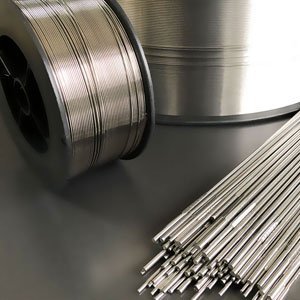
Fully Austenitic 25Cr-20Ni Filler Metal for Extreme Oxidation Resistance & Cryogenic Toughness
Stainless Steel ER310 Filler Wire (classified under AWS A5.9 ER310 and EN ISO 14343-A 25 20) is a high-alloy 25.0–28.0% Chromium / 20.0–22.5% Nickel fully austenitic welding wire designed primarily for joining wrought and cast heat-resisting steels of similar composition (such as AISI 310, 310S, 314 and ASTM A297 HK castings). Its high chromium and nickel contents form a tightly adherent protective oxide scale that resists scaling and oxidation in air up to 1150°C (2100°F).
Because ER310 solidifies as 100% stable austenite with zero delta-ferrite (0 FN), it avoids the formation of brittle sigma phase to the extent seen in ferrite-bearing stainless welds during prolonged high-temperature exposure, and also retains exceptional Charpy V-notch impact toughness down to liquid helium/nitrogen cryogenic temperatures (-196°C to -269°C).
Alloy Identification, Standards & Supply Specifications
Because fully austenitic 25Cr-20Ni weld metal contains no delta-ferrite, low phosphorus and sulfur impurities along with low-heat-input stringer-bead welding procedures are critical to prevent hot solidification cracking.
| Product Designation | Stainless Steel ER310 Filler Wire (TIG Welding Rod / MIG Spooled Wire) |
|---|---|
| AWS / ASME Classification | AWS A5.9 / ASME SFA-5.9 ER310 |
| EN / ISO Classification | EN ISO 14343-A W/G 25 20 (W.Nr. 1.4842) |
| UNS Designation & Werkstoff Nr. | UNS S31080 • W.Nr. 1.4842 |
| Compatible Base Materials | AISI 310, 310S, 310H (UNS S31000, S31008, S31009), AISI 314, cast HK-40 heat-resistant furnace alloys, and dissimilar joints or hard-to-weld armor/austenitic steels. |
| Supported Welding Processes | GTAW (TIG), GMAW (MIG) |
| Shielding Gas Recommendations | 100% Argon (GTAW); Ar + 1–2% O2 (GMAW) |
| Available Wire Diameters | MIG Spools: 0.8mm (.030"), 0.9mm (.035"), 1.0mm (.040"), 1.2mm (.045"), 1.6mm (1/16") TIG Cut-Length Rods: 1.2mm, 1.6mm (1/16"), 2.0mm, 2.4mm (3/32"), 3.2mm (1/8"), 4.0mm (5/32") × 914mm (36") / 1000mm |
| Packaging & Storage | TIG Rods: 5 kg / 10 kg moisture-resistant tubular plastic packs in export master cartons. MIG Wire: 12.5 kg / 15 kg precision layer-wound BS300 / S200 spools sealed in VCI polyethylene film. Storage: Store in a dry, temperature-controlled indoor store (+10°C to +40°C, <60% RH) in original sealed packaging. |
Chemical Composition Specification (AWS A5.9 / ASME SFA-5.9 ER310)
The table below specifies the standard wire chemical composition limits in weight percent (wt.%). Single values represent maximum permissible limits unless stated otherwise:
| Element | Verified Specification Limit (wt.%) | Metallurgical Function in Weld Metal |
|---|---|---|
| Chromium (Cr) | 25.0 – 28.0 | Provides high-temperature scaling and oxidation resistance up to 1150°C |
| Nickel (Ni) | 20.0 – 22.5 | Maintains a stable 100% austenitic matrix resistant to thermal cycling spallation |
| Carbon (C) | 0.08 – 0.15 | Controlled carbon provides elevated-temperature creep strength |
| Manganese (Mn) | 1.0 – 2.5 | Binds sulfur and suppresses hot cracking in fully austenitic welds |
| Silicon (Si) | 0.30 – 0.65 | Kept within controlled limits to balance oxidation resistance and crack immunity |
| Molybdenum (Mo) | 0.75 max | Residual limit |
| Copper (Cu) | 0.75 max | Residual limit |
| Phosphorus (P) & Sulfur (S) | P ≤ 0.030, S ≤ 0.030 (Low-impurity heats preferred) | Strictly limited to prevent grain-boundary liquation cracking |
| Iron (Fe) | Remainder | Matrix balance |
Mechanical & Physical Properties
The values below distinguish between minimum AWS/ISO classification requirements for all-weld-metal test assemblies and typical as-welded deposited weld metal benchmarks:
| Property | Value | Unit | Specification / Reference Basis |
|---|---|---|---|
| Tensile Strength | ≥ 550 (Typical: 590 – 640) | MPa | AWS A5.9 / Typical All-Weld-Metal Deposit |
| Yield Strength (0.2% Offset) | ≥ 350 (Typical: 390 – 430) | MPa | Typical As-Welded GTAW Deposit |
| Elongation | ≥ 30 (Typical: 35 – 40) | % | In 5D / 50 mm Gauge Length |
| Ferrite Number (FN) | 0 (100% Fully Austenitic) | FN | WRC-1992 Constitution Diagram |
| Max Scaling Service Temp. | 1150 (Continuous) / 1050 (Cyclic) | °C | In Oxidizing Air Atmosphere |
| Density | 7.90 | g/cm³ | Physical Property Reference |
Corrosion Resistance, Welding Considerations & Industrial Applications
When welding with ER310 filler wire, maintain a low interpass temperature (≤100–120°C), use narrow stringer beads with a slightly convex bead profile (avoid deep, narrow weld penetration ratios >1:1), and fill all arc craters carefully before extinguishing the arc.
Typical Industrial Applications
- Industrial heat-treating furnaces, radiant tubes, muffles, retorts, annealing covers and burner nozzles
- Cement kiln nose-ring segments, calciner ducts and ore roasting furnace internals
- Petrochemical reformer tube assemblies, flare tips and refinery catalyst regeneration internals
- Thermal power boiler tube supports, soot-blower elements and superheater hangers
- Cryogenic vessels and structural components operating down to -196°C / -269°C
International Enquiry Destinations
FillerWires welcomes B2B export enquiries for Stainless Steel ER310 Filler Wire from EPC contractors, process equipment fabricators, shipyards and distributors across the following priority countries and industrial cities:
| Target Country | Relevant Industrial Cities & Ports | Typical Regional Sector Demand |
|---|---|---|
| Saudi Arabia & UAE | Jubail, Yanbu, Dammam, Riyadh, Abu Dhabi, Ruwais, Dubai, Ras Al Khaimah | Petrochemical furnaces, flare tips & cement kilns |
| Oman, Qatar, Kuwait & Bahrain | Sohar, Muscat, Salalah, Mesaieed, Ras Laffan, Ahmadi, Shuaiba, Manama | Refinery heaters, power boilers & aluminium/steel furnaces |
| United States & United Kingdom | Houston, Pittsburgh, Cleveland, Detroit, Sheffield, Birmingham | Heat-treating furnaces, steel mills & petrochemical heaters |
| Germany, Italy & Europe | Düsseldorf, Essen, Duisburg, Milan, Brescia, Turin, Katowice/Kraków | Furnace engineering, steelmaking & boiler fabrication |
| South Africa, Peru, Singapore & Sri Lanka | Johannesburg, Newcastle, Rustenburg, Lima, Arequipa, Jurong, Colombo | Pyrometallurgical smelters, cement kilns & refinery heaters |
Frequently Asked Questions — Stainless Steel ER310 Filler Wire
Technical questions and answers regarding classification, base metal compatibility, welding parameters and procurement for Stainless Steel ER310 Filler Wire:
Stainless Steel ER310 Filler Wire is classified under AWS A5.9 / ASME SFA-5.9 ER310 and EN ISO 14343-A W/G 25 20 (W.Nr. 1.4842) (UNS UNS S31080, Werkstoff Nr. 1.4842). Contact us for confirmed product specifications and available technical documentation.
Stainless Steel ER310 Filler Wire (AWS A5.9 / ASME SFA-5.9 ER310) is engineered for welding AISI 310, 310S, 310H (UNS S31000, S31008, S31009), AISI 314, cast HK-40 heat-resistant furnace alloys, and dissimilar joints or hard-to-weld armor/austenitic steels.
Stainless Steel ER310 Filler Wire is supplied for GTAW (TIG), GMAW (MIG) as precision layer-wound MIG spools (0.8mm, 0.9mm, 1.0mm, 1.2mm, 1.6mm) and straight cut-length TIG rods (1.2mm, 1.6mm, 2.0mm, 2.4mm, 3.2mm, 4.0mm in 914mm / 36-inch and 1000mm lengths). Recommended shielding gas: 100% Argon (GTAW); Ar + 1–2% O2 (GMAW).
When welding with ER310 filler wire, maintain a low interpass temperature (≤100–120°C), use narrow stringer beads with a slightly convex bead profile (avoid deep, narrow weld penetration ratios >1:1), and fill all arc craters carefully before extinguishing the arc. Typical applications include: Industrial heat-treating furnaces, radiant tubes, muffles, retorts, annealing covers and burner nozzles; Cement kiln nose-ring segments, calciner ducts and ore roasting furnace internals; Petrochemical reformer tube assemblies, flare tips and refinery catalyst regeneration internals.
International B2B Technical Enquiry & Quotation Request
Submit your alloy grade, AWS/ISO classification, diameter, welding process and delivery destination. Our technical export team in Mumbai responds to enquiries from the Middle East, GCC, USA, UK, Europe, Singapore, Sri Lanka, South Africa, Peru and global markets.